Major Arcana · Card XII
The Hanged Man
A pause that turns the world, and your view of it, upside down.
- Yes or no: Maybe
- Western astrology: the element of Water
The Hanged Man tarot card description
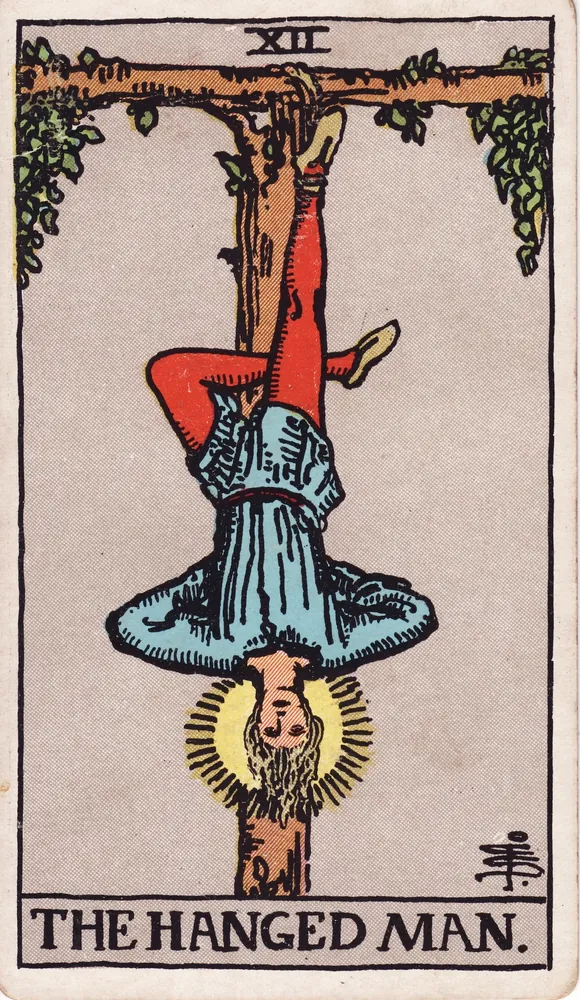
A young man hangs upside down by one foot from a living, T-shaped tree, his other leg bent behind the first and his hands behind his back. His face is calm, and a soft halo of light glows around his head.
He hangs by choice, not in suffering: the calm face and the halo show that he has found understanding by seeing the world the other way up. The living tree is growth that continues even in stillness.
The Hanged Man upright
The Hanged Man asks for a pause: to let go of control, to wait, and to allow a new understanding to arrive.
What looks like a delay may be exactly the pause you need. Seeing a situation from a new angle can change everything.
Love and relationships
Waiting, or seeing a relationship in a new light; letting go of the need to control it.
Finances
Hold off on big decisions; a pause now can prevent a mistake.
Career
A project on hold; an opportunity to rethink your approach.
Health and wellbeing
Rest and stillness help; do not force your recovery.
The Hanged Man reversed
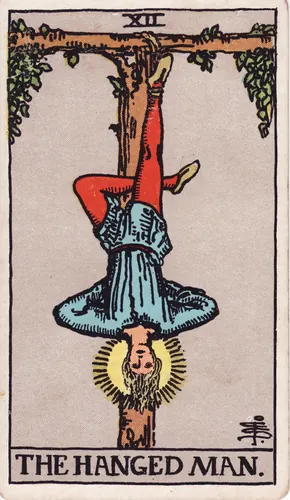
Reversed, it can mean stalling, indecision, or a sacrifice that achieves nothing.
It can also mean resisting a pause you need. Ask what you are holding on to.
Love and relationships
Stuck in the same place; something has to change.
Finances
Delays or waiting too long to act.
Career
Stagnation; a decision long overdue.
Health and wellbeing
Restlessness; accept the rest your body asks for.
Health readings describe wellbeing within the tradition. They are not medical advice; for any health concern, see a doctor.
The Hanged Man: one-card pull, yes or no
Drawn as a single card for a yes-or-no question, The Hanged Man is usually read like this:
Upright
Maybe
wait, and look at it from another angle.
Reversed
No
not while you are stuck.
The Hanged Man for timing
Linked with the element of Water. In timing it almost always means a pause: slower than you would like, and worth waiting for.
These correspondences come from the Western tarot tradition, which uses the tropical zodiac. They are not part of Vedic astrology, whose signs are counted differently.
The card’s adviceLook at it the other way up.
The Major Arcana tarot card meanings
Want a reading about your own question?
Talk to an astrologer on a call or a chat. Choose someone who lists tarot among their specialisations.
Tarot is a tool for reflection. No card fixes an outcome, and a reading is not medical, legal or financial advice. Card images: the Rider–Waite–Smith tarot, illustrated by Pamela Colman Smith (1909), public domain.