Major Arcana · Card XIII
Death
An ending that makes room for a beginning.
- Yes or no: No
- Western astrology: Scorpio
Death tarot card description
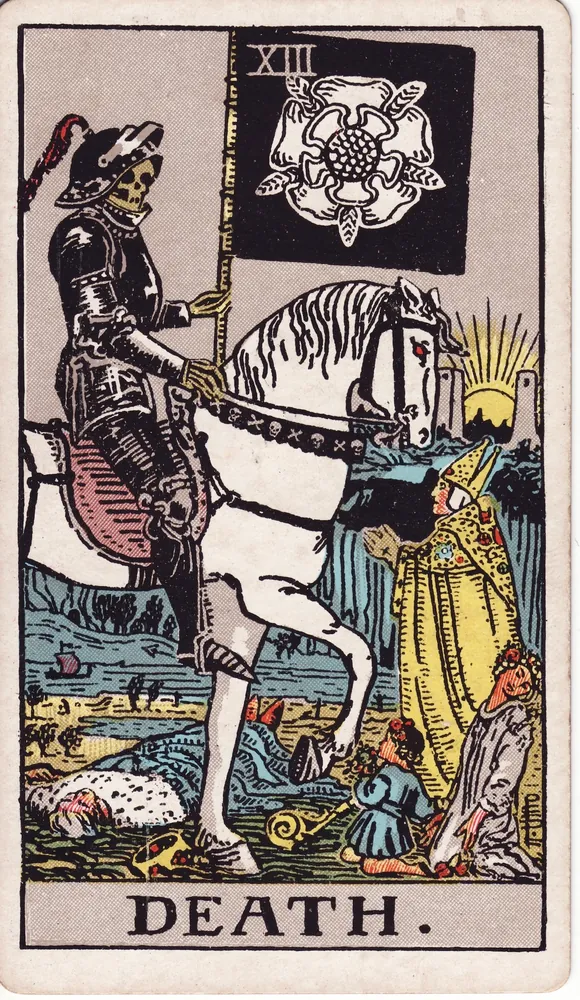
A figure in black armour rides a white horse, carrying a black banner that bears a white rose. In the distance the sun rises between two towers.
The rider is change that comes to everyone, which is why the card is calm rather than cruel. The white rose is purity and renewal, and the rising sun between the towers promises that after every ending, a new day begins.
Death upright
Despite its name, the Death card almost never means a physical death. It marks an ending that makes way for something new: a chapter closing, a habit or a relationship coming to an end, a deep transformation.
What is over is allowed to be over. Letting go clears the ground for the next beginning.
Love and relationships
The end of one phase of a relationship and the start of another; sometimes an ending that frees both people.
Finances
An old way of managing money ends; a fresh start.
Career
A role or project ending; a transformation or a change of career.
Health and wellbeing
Letting go of an old habit makes room for renewal.
Death reversed
Reversed, you may be clinging to what has already ended, or fear of change may be keeping you stuck.
The change will come; accepting it makes it easier.
Love and relationships
Holding on to a relationship or a past that has ended.
Finances
Resisting a necessary change in how you handle money.
Career
Staying in a role you have outgrown.
Health and wellbeing
Holding on to habits that no longer serve you.
Health readings describe wellbeing within the tradition. They are not medical advice; for any health concern, see a doctor.
Death: one-card pull, yes or no
Drawn as a single card for a yes-or-no question, Death is usually read like this:
Upright
No
not in the way you expect; something is ending so something new can begin.
Reversed
No
not until you let go.
Death for timing
Linked with Scorpio, whose Western season runs from about 23 October to 21 November. In timing it marks the end of a cycle before a new one starts.
These correspondences come from the Western tarot tradition, which uses the tropical zodiac. They are not part of Vedic astrology, whose signs are counted differently.
The card’s adviceLet what is over be over.
The Major Arcana tarot card meanings
Want a reading about your own question?
Talk to an astrologer on a call or a chat. Choose someone who lists tarot among their specialisations.
Tarot is a tool for reflection. No card fixes an outcome, and a reading is not medical, legal or financial advice. Card images: the Rider–Waite–Smith tarot, illustrated by Pamela Colman Smith (1909), public domain.