STELLAASTROLOGY

Kundli Matching · कुंडली मिलान

Two charts, read together

Compare two birth charts the traditional way: the eight kootas of Guna Milan, scored out of 36 from each partner’s Moon.

Two birth charts and a pair of golden rings above a lotusA little perspective. A more mindful day.

Stella calculation · Swiss Ephemeris

Match two Kundlis

Enter both sets of birth details. Stella works out each Moon’s sign and nakshatra and scores the eight kootas of Guna Milan, out of 36.

Calculation method

Ashtakoota (Guna Milan), from each partner’s Moon: sidereal, True Chitrapaksha ayanamsa, the settings of Jagannatha Hora. The koota tables match ProKerala’s on all 60 test pairs, point for point. Traditional exceptions are named beside the score, never added to it.

Bride’s birth details

District headquarters: New Delhi · 28.6139, 77.209 · India Standard Time rules for the date entered.

Groom’s birth details

District headquarters: New Delhi · 28.6139, 77.209 · India Standard Time rules for the date entered.

The dates, times and coordinates are sent to Stella’s calculation service and not stored. No names are needed. Privacy details

Start here

What is Kundli Matching?

Kundli Matching (Kundli Milan) is the traditional comparison of two birth charts before a marriage. In most Indian families it begins with Guna Milan, the method called Ashtakoota: eight tests, the kootas, which compare the Moon of one partner with the Moon of the other.

Each koota is worth a fixed number of points, from 1 for Varna to 8 for Nadi, for 36 points in all. The total is the Guna Milan score. Tradition treats 18 as the minimum for a match to be considered, and looks closely at two doshas, Nadi and Bhakoot, whatever the total.

Guna Milan is a starting point, not a verdict. It compares only the two Moons, the mind and the emotions in Jyotisha. An astrologer also reads both full charts: the seventh house of marriage, Venus, Jupiter, the Manglik placement and the periods each person is running.
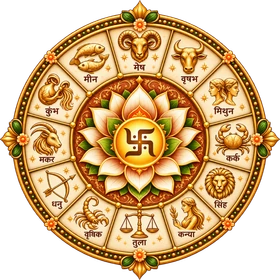
Two Kundli charts side by side with a golden heart between them

The eight tests

The eight kootas

Each koota looks at a different side of a partnership, and each is worked out from the Moon sign or the Moon nakshatra of each partner. These are the rules Stella’s calculator applies.

1Varna2Vashya3Tara4Yoni5Maitri6Gana7Bhakoot8Nadi1 + 2 + … + 8 = 36 points
BrahminCancer · Scorpio · PiscesKshatriyaAries · Leo · SagittariusVaishyaTaurus · Virgo · CapricornShudraGemini · Libra · Aquarius1 point when the groom’s varna ranks at or above the bride’s

Varna (1 point): outlook

The Moon signs fall into four varnas: Brahmin (Cancer, Scorpio, Pisces), Kshatriya (Aries, Leo, Sagittarius), Vaishya (Taurus, Virgo, Capricorn) and Shudra (Gemini, Libra, Aquarius). Tradition reads Varna for outlook and temperament, and gives the point when the groom’s varna ranks at or above the bride’s.

1QuadrupedAries, Taurus, Sgr 15–30°, Cap 0–15°2HumanGemini, Virgo, Libra, Sgr 0–15°, Aquarius3WaterCancer, Pisces, Cap 15–30°4WildLeo5InsectScorpioSame group 2 points · predator and prey 0

Vashya (2 points): attraction

Vashya means influence: how naturally one partner draws the other. The signs form five groups: quadruped, human, water-dwelling, wild (Leo) and insect (Scorpio), with Sagittarius and Capricorn split at 15°. Partners in the same group score 2; a predator and its prey, such as the lion and a quadruped, score 0.

123456789123456789123456789birth star1 to 9counted from the birth star,three times round3, 5 and 7 unfavourable

Tara (3 points): wellbeing

Tara counts the nakshatras from the bride’s birth star to the groom’s, and from his to hers. Each count, divided by nine, lands on one of nine taras; the third, fifth and seventh (Vipat, Pratyak and Naidhana) are unfavourable. Each favourable direction earns 1½ points.

Fourteen yonis; seven pairs of sworn enemiesHorse0BuffaloElephant0LionSheep0MonkeySerpent0MongooseDog0DeerCat0RatCow0Tiger

Yoni (4 points): physical harmony

Each nakshatra has an animal, its yoni: fourteen in all, from the horse and the elephant to the mongoose and the lion. The same animal scores 4, friendly animals 3, neutral 2 and unfriendly 1. The seven pairs of sworn enemies, such as the cat and the rat or the cow and the tiger, score 0.

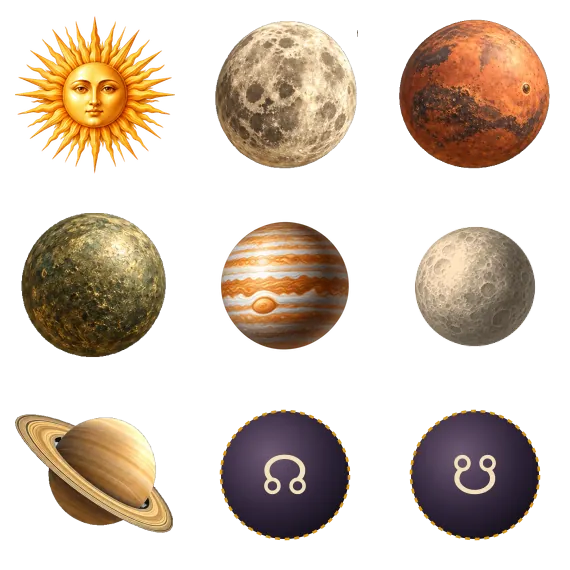
The nine grahas in a circle

Graha Maitri (5 points): friendship of the mind

The lords of the two Moon signs are compared by their natural friendship, as Parashara gives it: the Sun is a friend of the Moon, Mars and Jupiter, for example, and Saturn of Mercury and Venus. The same lord, or two lords who are friends, score 5; two lords who are enemies score 0. It is read for mental compatibility and friendship.

Devadivine9Manushyahuman9Rakshasafierce9Nine nakshatras in each ganaSame gana: 6 points

Gana (6 points): nature

The nakshatras fall into three ganas of nine: Deva (divine), Manushya (human) and Rakshasa (fierce and independent, not evil). The same gana scores 6, as does a Deva groom with a Manushya bride; the reverse scores 5. A Rakshasa with a Manushya partner scores 0.

1234567891011121 is one partner’s Moon sign;the other’s falls in one of 1 to 127 pointsBhakoot dosha, 0

Bhakoot (7 points): family welfare

Bhakoot counts how far apart the two Moon signs are. Signs 1/1, 3/11, 4/10 or 7/7 apart score 7. Signs 2/12, 5/9 or 6/8 apart score 0: this is Bhakoot dosha, traditionally linked with family welfare, finances and the couple’s growth together.

Adi (Vata)Madhya (Pitta)Antya (Kapha)The same nadi for both: Nadi dosha, 0 of 8

Nadi (8 points): health and children

The nakshatras cycle through three nadis: Adi (Vata), Madhya (Pitta) and Antya (Kapha). Different nadis score all 8 points. The same nadi scores 0: this is Nadi dosha, the one families take most seriously, traditionally linked with health and with children.

What families look for

Doshas in matching

Three doshas are weighed alongside the score. Stella shows each one, and names any traditional exception that applies beside the score, but never adds it to the score: which exceptions count, and how much, is for your astrologer.

  • Nadi dosha: both Moons in the same nadi. Tradition often sets it aside when both Moons are in the same sign but different nakshatras, in the same nakshatra but different signs, or in the same nakshatra but different padas.

  • Bhakoot dosha: the Moon signs 2/12, 5/9 or 6/8 apart. Tradition often sets it aside when the two signs share a lord, or their lords are friends of each other.

  • Manglik: Mars in the 1st, 4th, 7th, 8th or 12th house from the Lagna, the Moon or Venus. Stella shows each partner’s placement; tradition often considers two Manglik charts to balance each other.

The planet Mars

Your result

Reading the score

The traditional reading of the 36-point total:

  • 33 to 36: excellent, the highest band.

  • 25 to 32½: very good.

  • 18 to 24½: acceptable: at or above the traditional minimum.

  • Below 18: under the traditional minimum; most families would ask an astrologer to read both charts in full.

Many astrologers look at Nadi and Bhakoot before the total: a high score with Nadi dosha is often read more cautiously than a lower score without it.

Below 18AcceptableVery goodExcellent018253336The traditional reading of the 36-point score

Beyond the score

What an astrologer adds

A marriage is more than two Moons. In a consultation an astrologer can also look at:

  • The seventh house: the house of partnership in each chart, its sign, its lord and the planets in it.

  • Venus and Jupiter: the significators of marriage, and their strength in each chart.

  • The dashas: the periods each person is running, and the timing of the marriage.

  • Your own questions: values, family, work and hopes: the things no chart can decide for you.

Kundli Matching describes compatibility within a tradition. It does not decide a marriage, and no score guarantees happiness or foretells difficulty.

Two cups of tea beside a birth chart and a lotus

Before you begin

Come as you are.
Bring a little context.

  • Both dates of birth
  • Both birth times, as exact as you have them, and where each came from
  • Both places of birth: a city, or the coordinates
  • The questions you would like an astrologer to look at

Some questions deserve a conversation.

Explore our astrologer profiles and find a guide for your next step.

Talk to Astrologer ↗