STELLAASTROLOGY

Panchang · दैनिक पंचांग

A rhythm for your day

Meet the traditional calendar, its five elements, and the observances that connect us.

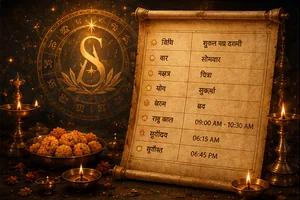
Panchang illustration inspired by Indian celestial artA little perspective. A more mindful day.

Stella calculation · Swiss Ephemeris

Calculate the Panchang for a day and place

Today’s Panchang for New Delhi is below. Choose a date and place to see the five elements of the day, sunrise, sunset and moon timings, and Rahu Kaal with the day’s other periods.

Calculation method

Sidereal, True Chitrapaksha ayanamsa, whole-sign houses, mean Rahu and Ketu, sunrise when the centre of the Sun is on the horizon: the settings of Jagannatha Hora, against which this calculation has been checked.

District headquarters: New Delhi · 28.6139, 77.209 · India Standard Time rules for the date entered.

The date, time and coordinates are sent to Stella's calculation service and not stored. No name is needed. Privacy details

Calculated by Stella · stella-jyotish-1.10

Today’s Panchang · New DelhiSaturday, 3 October 2026

2026-10-03 · 12:00:00 · UTC+05:30 (Asia/Kolkata rules for this date) · New Delhi · 28.6139, 77.209

Vara
Shanivara (Saturday)
Sunrise
06:18:51
Sunset
18:01:14
Moonrise
23:31:50
Moonset
13:04:21

Inauspicious times

  • Rahu Kaal09:14 – 10:423rd eighth of the daytime
  • Yamaganda13:38 – 15:066th eighth of the daytime
  • Gulika Kaal06:19 – 07:471st eighth of the daytime
  • Dur Muhurtam06:19 – 07:061st of the day’s 15 muhurtas
  • Dur Muhurtam07:06 – 07:532nd of the day’s 15 muhurtas

Auspicious times

  • Brahma Muhurta04:41 – 05:3014th of the night’s 15 muhurtas
  • Abhijit Muhurta11:47 – 12:338th of the day’s 15 muhurtas

Rahu Kaal, Yamaganda and Gulika Kaal are each an eighth of the daytime, from sunrise to sunset; a muhurta is a fifteenth of the day or the night. They follow Stella’s sunrise, when the centre of the Sun is on the horizon, which is a few minutes after the visible sunrise many printed panchangs use.

Tithi

Krishna Saptami
2 Oct, 10:16:19 → 3 Oct, 08:00:44

Krishna Ashtami
3 Oct, 08:00:44 → 4 Oct, 05:52:50

Krishna Navami
4 Oct, 05:52:50 → 5 Oct, 03:54:53

Nakshatra

Ardra
3 Oct, 02:53:34 → 4 Oct, 01:28:16

Punarvasu
4 Oct, 01:28:16 → 5 Oct, 00:12:24

Yoga

Variyana
2 Oct, 18:14:08 → 3 Oct, 15:18:02

Parigha
3 Oct, 15:18:02 → 4 Oct, 12:28:47

Karana

Bava
2 Oct, 21:07:45 → 3 Oct, 08:00:44

Balava
3 Oct, 08:00:44 → 3 Oct, 18:55:40

Kaulava
3 Oct, 18:55:40 → 4 Oct, 05:52:50

Taitila
4 Oct, 05:52:50 → 4 Oct, 16:52:29

The Hindu day runs from sunrise to the next sunrise, so an element can begin before this sunrise or end after the next. Each start and end is found to the second.

Ayanamsa 24° 12′ 53″ (True Chitrapaksha). Times are shown by the birth place's clock at UTC+05:30.

Talk to an astrologer ↗

Source code of Stella's calculation engine (AGPL-3.0), exactly as it ran for this result.

Start here

What is a Panchang?

Panchang (Panchangam in the South) means “five limbs”: *pancha*, five, and *anga*, limb. It is the traditional Hindu almanac, and for centuries it has been the calendar Indian families consult before a wedding, a housewarming, a journey, a fast or a festival.

A civil calendar tells you only the date. A Panchang describes the quality of the day by five measurements of the sky: the lunar day (tithi), the weekday (vara), the Moon’s star (nakshatra), the combined motion of the Sun and the Moon (yoga) and the half lunar day (karana). Together they show which days and hours tradition considers favourable for which kinds of work.

Why the place matters. Every limb is counted from sunrise, and sunrise differs from city to city. The same tithi can be in force at sunrise in Chennai and not yet in Delhi, which is why two families can keep the same festival on different dates, and why the calculator asks for a place as well as a date.

An open almanac scroll beside a brass lamp, with the Sun and the Moon above it

The five limbs

What does a Panchang show?

Each limb below matches a row of the calculator above. Read them beside your own result: first the day itself, from sunrise to the next sunrise, then the five limbs in order.

Tithilunar dayVaraweekdayNakshatraMoon’s starYogaSun + MoonKaranahalf tithiPancha + anga: the five limbs of the day
SunriseSunsetMidnightNext sunriseOne Hindu day runs from sunrise to sunrise

The Hindu day: from sunrise to sunrise

Unlike the civil day, which turns at midnight, the Hindu day begins at sunrise and runs to the next sunrise. The weekday and the tithi that name a day are the ones in force at sunrise at your place.

So a limb can change at any hour: a tithi might begin at 3 in the afternoon and end at 1 the next afternoon. Stella’s Panchang lists every limb that touches the day, each with its start and end to the second, together with sunrise, sunset, moonrise and moonset.

PurnimaAmavasyaShuklabright halfKrishnadark half30 tithis in a lunar month, 15 in each half

Tithi: the lunar day

A tithi is the time the Moon takes to move 12° ahead of the Sun. There are thirty in a lunar month: fifteen in the bright half, Shukla paksha, from Pratipada to Purnima (full moon), and fifteen in the dark half, Krishna paksha, from Pratipada to Amavasya (new moon).

Because the Moon’s speed changes, a tithi lasts anywhere from about 19 to 26 hours. Many observances follow the tithi: the Ekadashi fasts, Chaturthi for Ganesha, Purnima and Amavasya. Occasionally a tithi begins and ends between two sunrises and never names a day, or spans two sunrises and names both.

SunRavi · SunMonSoma · MoonTueMangala · MarsWedBudha · MercuryThuGuru · JupiterFriShukra · VenusSatShani · Saturn7varas, each ruled by a graha

Vara: the weekday and its planet

The seven varas are named after the grahas that rule them: Ravivara (Sunday, the Sun), Somavara (Monday, the Moon), Mangalavara (Tuesday, Mars), Budhavara (Wednesday, Mercury), Guruvara (Thursday, Jupiter), Shukravara (Friday, Venus) and Shanivara (Saturday, Saturn).

The ruling planet colours the day in tradition, which is why many people keep a Monday fast for Shiva, visit a Hanuman temple on Tuesday or Saturday, or begin learning on a Thursday. The vara, too, changes at sunrise, not at midnight.

12345678910111213141516171819202122232425262727nakshatras of 13°20′the Moon in Rohini (4)

Nakshatra: the Moon’s star

The zodiac is divided into 27 nakshatras of 13°20′, and the Moon passes through all of them in about 27 days, roughly one a day. The day’s nakshatra is the one the Moon occupies.

Nakshatras matter most when choosing a time for an event, and for naming ceremonies. Some are traditionally favoured for beginnings, such as Rohini, Pushya and the three Uttaras, and some festivals are fixed by the nakshatra: Onam is kept on Thiruvonam (Shravana).

A golden Sun

Yoga: the Sun and the Moon together

The yoga is found by adding the longitudes of the Sun and the Moon and dividing the total into 27 equal parts. Each part has a name, from Vishkambha to Vaidhriti, and lasts about a day.

Most yogas are treated as favourable or neutral. A few, above all Vyatipata and Vaidhriti, are traditionally avoided for new beginnings.

A golden crescent Moon

Karana: half a tithi

Each tithi divides into two karanas, so there are sixty in a lunar month, drawn from eleven names. Seven repeat through the month: Bava, Balava, Kaulava, Taitila, Gara, Vanija and Vishti. Four occur once each, around the new moon: Shakuni, Chatushpada, Naga and Kimstughna.

Vishti, better known as Bhadra, is traditionally avoided for starting anything important.

Why it matters

What the Panchang is used for

No single limb makes a day good or bad. A priest or an astrologer weighs the five together, with the purpose in mind, and often with the chart of the person concerned. These are the occasions families most often open the Panchang for:

  • Two gold rings on a lotus

    Marriage: the wedding day and hour are chosen from the tithi, the nakshatra and the yoga, together with the couple’s charts.

  • Brass scales, coins and a ledger

    Business and new ventures: opening a shop, signing an agreement or starting work on a day with a favourable nakshatra and no Bhadra.

  • Golden stars across the sky

    Naming ceremony: the Namkaran is traditionally held on a chosen day, and the child’s nakshatra and pada suggest the first syllable of the name.

  • A house with a brass compass and a rolled plan

    Travel: tradition prefers certain weekdays and nakshatras for setting out on a journey, and avoids others.

  • A brass kalash and a lit diya with flowers

    Fasts and festivals: Ekadashi, Pradosh, Sankashti Chaturthi, Purnima and the great festivals are all fixed by the tithi at sunrise.

Almanacs also mark the day’s own periods, such as Rahu Kaal, that tradition avoids for new beginnings. Stella’s Panchang gives them too; the next section explains them.

Brass diyas, marigolds and a kalash arranged for a festival

Times of the day

Rahu Kaal and the day’s periods

Besides the five limbs, a Panchang divides the day itself. The daytime, from sunrise to sunset, is cut into eight equal parts and into fifteen muhurtas, and the night is cut the same way. Which part is avoided or favoured depends on the weekday, so these periods move every day, and with the season and the place. Stella’s Panchang gives them for your date and city:

  • Rahu Kaal: the eighth of the daytime ruled by Rahu: the 2nd on Monday, the 3rd on Saturday, the 4th on Friday, the 5th on Wednesday, the 6th on Thursday, the 7th on Tuesday and the 8th on Sunday. Tradition avoids beginning anything new in it.

  • Yamaganda: another eighth of the daytime, set by the weekday and avoided in the same way.

  • Gulika Kaal: the eighth ruled by Gulika, the son of Saturn; many families avoid it for new work too.

  • Dur Muhurtam: one or two of the day’s fifteen muhurtas, set by the weekday; on a Tuesday the second falls at night.

  • Abhijit Muhurta: the 8th of the day’s muhurtas, around midday, traditionally good for starting work when no other muhurta can be found. Not on a Wednesday: then it is also the Dur Muhurtam, and Stella says so beside it.

  • Brahma Muhurta: the 14th of the night’s fifteen muhurtas, ending one muhurta before sunrise: the time tradition recommends for waking, prayer and study.

Stella’s times follow its sunrise, when the centre of the Sun is on the horizon. Almanacs that count from the first visible edge of the Sun give these periods a few minutes differently; the rule is the same.

A Monday, from sunrise to sunsetThe daytime in eighths12345678RahuYamaGulikaThe daytime in fifteen muhurtas123456789101112131415AbhijitDurDurSunriseMiddaySunset

Before you calculate

Reading Stella’s Panchang

The page opens on today’s Panchang for New Delhi. Choose a date and a place and Stella calculates the Panchang for that location. A few things help you read it well:

  • Pick the place you are in: sunrise, and so every limb, depends on where you are. Choose your district, or custom coordinates to use this device’s own location.

  • Read the start and end times: a limb shown with two times begins or ends during the day; the one in force at sunrise names the day.

  • Know your calendar: in much of North India the month ends at the full moon (purnimanta); in the South and West at the new moon (amanta). The tithi is the same, but the month name can differ.

  • For an event, ask: a Panchang shows the day; choosing a muhurta for a wedding or a housewarming also uses the charts of the people involved.

Stella calculates the Panchang with the Swiss Ephemeris, using the same settings as Jagannatha Hora: the true Chitrapaksha ayanamsa and sunrise at the centre of the Sun’s disc. Nothing you enter is stored.

A Panchang scroll beside marigolds and a lamp
✧ Interactive preview · Free to explore

Get to know your daily Panchang

Select a date and place to explore how a calendar is presented. All values remain fixed illustrative examples, unrelated to the selected date or place.

District headquarters: New Delhi · 28.6139, 77.209

Actual timings need a verified calendar for your location. Sample times must not be used to schedule an observance.

Follow the five elements

Explore the vocabulary, timing windows and observances in a sample calendar.

Before you begin

Come as you are.
Bring a little context.

  • The date you want to explore
  • Your city and time zone
  • The calendar tradition followed by your family

Good questions

A little more clarity

Are these actual timings?

The calculator at the top of this page is: it opens on today for New Delhi, and Stella calculates sunrise, sunset, each element to the second, and Rahu Kaal with the day’s other periods, for any date and place. The illustrated explorer further down uses labelled sample values. Regional calendars can follow different conventions, so for observances follow the calendar of your tradition.

Why does a Panchang show a time after midnight?

Some calendars keep the following early morning within the previous sunrise-based day. Check the provider’s notation and date convention.

Why do two cities have different timings?

Sunrise and local time vary by location, affecting how calendar elements and observances are presented.

Some questions deserve a conversation.

Explore our astrologer profiles and find a guide for your next step.

Talk to Astrologer ↗