

STELLAASTROLOGY

Vaastu · वास्तु शास्त्र

Make room for harmony

Look at your home or workspace with fresh eyes, from its entrance to your quietest corner.

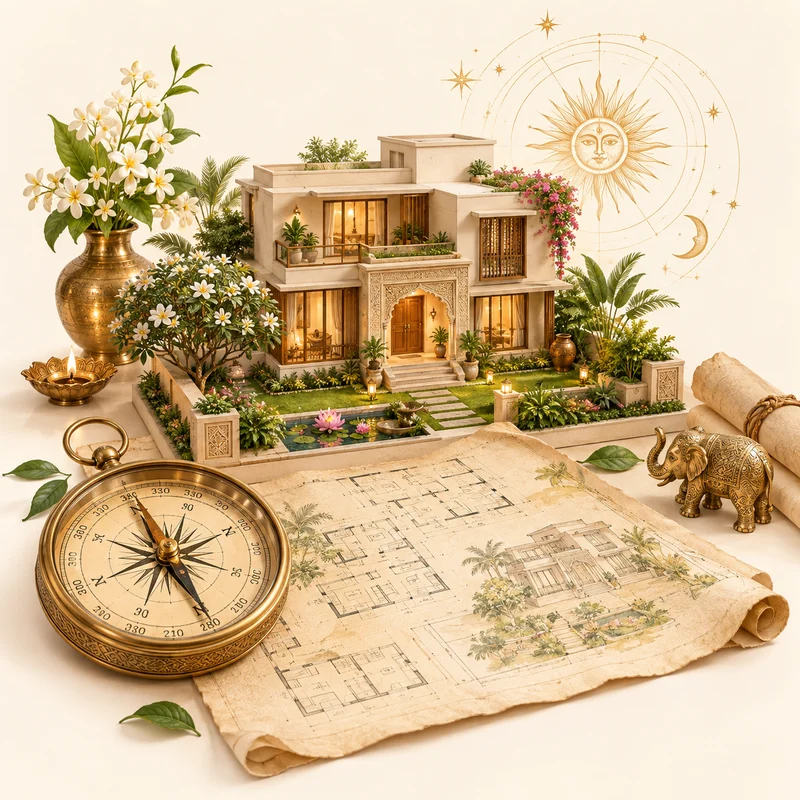
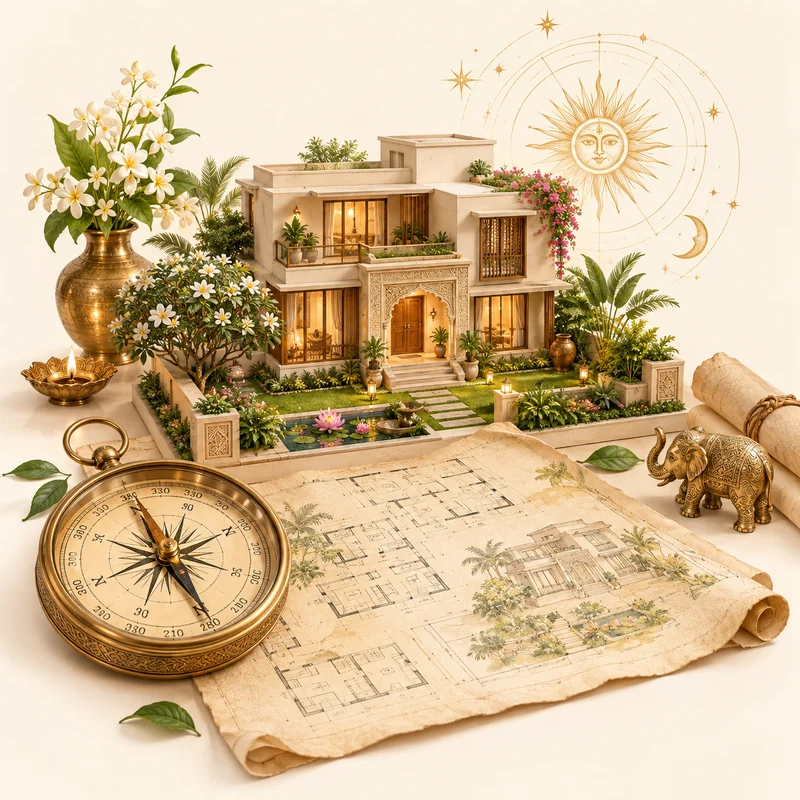
Vaastu illustration inspired by Indian celestial artA little perspective. A more mindful day.

Start here

What is Vaastu Shastra?

Vaastu Shastra, “the science of dwelling”, is India’s traditional knowledge of how buildings are placed, shaped and arranged. Its principles are set out in texts such as the Mayamatam, the Manasara and the Vishwakarma Prakash, and they shaped temples, palaces and homes across the subcontinent for centuries.

Vaastu sees a building as a living space held in balance between the five elements and the eight directions. When the parts of a home sit where their purpose fits, tradition holds that the home supports the health, harmony and work of the people in it.

Many Vaastu ideas meet good design: morning light from the east, air that moves through the house, a calm corner for prayer or study, an open, uncluttered centre. You do not need to rebuild a home to use them; most begin with the way a space is arranged.

A home with a garden, a brass compass and a floor plan

The foundations

The principles behind Vaastu

Three ideas run through every Vaastu recommendation: the elements, the directions and the plan of the site itself.

A house with a brass compass and a rolled plan
WaterJalaFireAgniEarthPrithviAirVayuSpaceAkashaNorthSouthNE water · SE fire · SW earth · NW air · space at the centre

The five elements (Panchabhuta)

Everything, in this view, is made of five elements, and each has its place in a home:

  • Earth (Prithvi): stability; the south-west, heavy walls and furniture.

  • Water (Jala): flow and renewal; the north-east, water sources and prayer.

  • Fire (Agni): energy and transformation; the south-east, the kitchen.

  • Air (Vayu): movement and freshness; the north-west, windows and guest rooms.

  • Space (Akasha): openness; the centre of the home, kept free.

NKuberaNEIshanyaEIndraSEAgniSYamaSWNairutyaWVarunaNWVayu

The eight directions

Each direction has a presiding deity and a purpose it suits. The north belongs to Kubera, wealth; the north-east (Ishanya) to the divine, and is kept the calmest and cleanest; the east to Indra and the rising Sun; the south-east (Agneya) to Agni, fire; the south to Yama, rest and stability; the south-west (Nairutya) to strength and steadiness; the west to Varuna; and the north-west (Vayavya) to Vayu, the wind.

Brahmasthankept openNE: the headThe Vaastu Purusha Mandala, a grid of 81 squares

The Vaastu Purusha Mandala

Traditional builders drew a square grid over the site, the Vaastu Purusha Mandala, with a cosmic figure lying across it, his head in the north-east. Each part of the grid belongs to a deity, and so suits a particular use.

The centre of the grid is the Brahmasthan, the place of Brahma. It is traditionally left open, with no pillars, heavy furniture or clutter, so that light and energy can move through the whole home.

Room by room

Vaastu for your home

These are the guidelines tradition gives most often. Where a home cannot follow one, practitioners suggest adjustments, never demolition.

  • Main entrance: north, east or north-east is preferred. Keep it well lit, clean and free of clutter, with a door that opens easily.

  • Kitchen: the south-east, the corner of fire, with the cook facing east. The north-west is the usual alternative.

  • Master bedroom: the south-west, the steadiest corner. Sleep with your head towards the south or the east, and avoid a mirror facing the bed.

  • Prayer room: the north-east, kept calm and uncluttered, with the deities facing west or east.

  • Living room: the north or the east, where morning light and visitors enter.

  • Study: the east, the north or the west; face east or north while studying.

  • Bathrooms: the north-west or the west; never in the north-east or at the centre of the home.

  • Heavy furniture and storage: along the south and west walls, leaving the north and east lighter and open.

A home at dusk beside a compass and a plan

Beyond the home

Offices, shops and small changes

The same principles guide a workplace: the owner’s seat in the south-west facing north or east, the cash box or safe opening towards the north (Kubera’s direction), an entrance that is bright and welcoming, and a centre kept open.

Much of Vaastu is practical and can be done without breaking a wall:

  • Let in morning light: open east-facing windows and keep them clear.

  • Declutter the centre: move heavy furniture from the middle of a room or home.

  • Mend what is broken: leaking taps, stopped clocks and stuck doors are traditionally seen as blocks.

  • Use the light corners well: plants or water in the north-east, lamps in the south-east.

Vaastu is a tradition, not a building code. Follow structural safety and local rules first, and consult a qualified architect or engineer before any building work. The room checklist on this page offers general suggestions; it does not assess your property. For advice on your own home, talk to an astrologer who lists Vastu among their specialisations.

Brass scales, coins and a ledger on a desk
✧ Interactive preview · Free to explore

A thoughtful walk through your space

Choose a room and try a practical checklist. This is a general guide, not a property assessment.

Select a room

Entrance · North-facing entrance

An inviting first impression

0 of 3 ideas explored

Ask your practitioner: How does the entrance orientation fit with the rest of my floor plan?

Orientation is included in your discussion brief; these practical suggestions do not change with direction.

Before you begin

Come as you are.
Bring a little context.

  • A simple floor plan
  • An accurately measured north direction
  • The purpose of each room
  • Your practical constraints and budget

Good questions

A little more clarity

Will I need to rebuild my home?

This guide focuses on small changes. A practitioner can discuss traditional suggestions, but any structural, electrical or building work requires a qualified professional.

Does this guide analyse my floor plan?

No. The interactive room selector displays general suggestions; it does not inspect a property.

Can I use this for a rented home?

Yes. Explore movable furniture, organisation and lighting while respecting your tenancy and accessibility needs.

Some questions deserve a conversation.

Explore our astrologer profiles and find a guide for your next step.

Talk to Astrologer ↗
Vaastu — Stella Astrology