STELLAASTROLOGY

Kundli · जन्म कुंडली

Your cosmic blueprint

Explore the stories in your birth chart, one planet and one possibility at a time.

Kundli illustration inspired by Indian celestial artA little perspective. A more mindful day.

Stella calculation · Swiss Ephemeris

Calculate your birth chart

Start with your birth details to explore your ascendant, planetary positions and birth nakshatra.

Calculation method

Sidereal, True Chitrapaksha ayanamsa, whole-sign houses, mean Rahu and Ketu, sunrise when the centre of the Sun is on the horizon: the settings of Jagannatha Hora, against which this calculation has been checked.

District headquarters: New Delhi · 28.6139, 77.209 · India Standard Time rules for the date entered.

The date, time and coordinates are sent to Stella's calculation service and not stored unless you choose to save the Kundli. No name is needed. Privacy details

Start here

What is a Kundli?

Kundli (also spelled Kundali) comes from the Sanskrit kuṇḍalī, something round or coiled. Astrologers once drew it by hand, as a circle or a square divided into twelve parts, and the word came to mean the birth chart itself: the Janam Kundli.

A Kundli is a map of the sky for one moment and one place: the moment and the place you were born. It records where the Sun, the Moon, Mars, Mercury, Jupiter, Venus and Saturn stood, together with Rahu and Ketu, the two points where the Moon’s path crosses the Sun’s. Each is placed in one of the twelve signs of the zodiac and one of the twenty-seven nakshatras, and the whole sky is divided into twelve houses, counted from the sign that was rising in the east.

In Jyotisha, the Indian astrological tradition, a Kundli is read as a whole: which planets sit in which houses, how strong they are in their signs, how they relate to one another, and which planetary period is running. It is a structured way to reflect on temperament, relationships, work, health and timing, and it is where most conversations with an astrologer begin.

Why the exact time matters. The rising sign changes about every two hours, and the Moon moves through a whole nakshatra in about a day. Two people born on the same day in the same city can have different Lagnas and different houses, and a few minutes can change the finer divisional charts. That is why the calculator asks for the exact time and place of birth.

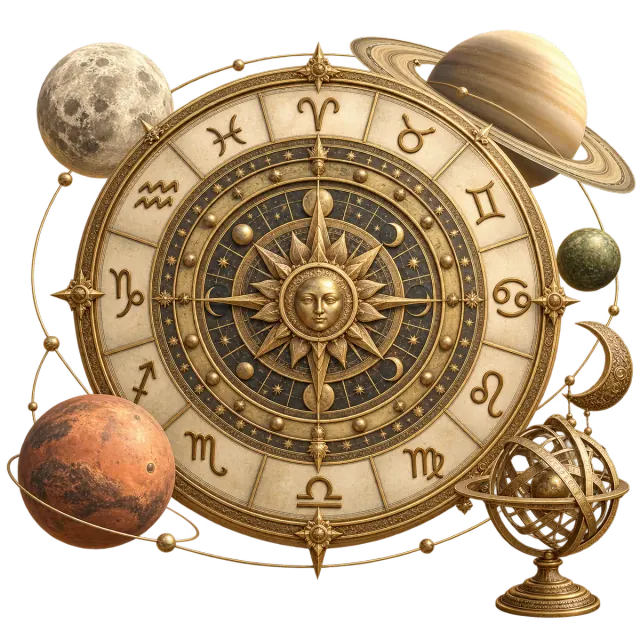
A carved zodiac wheel with the Sun, the Moon and planets around it

Reading your chart

What does your Kundli include?

Each part below matches something the calculator shows above, in the same order. Read it beside your own result, from the Lagna at the top to the dasha at the end.

A brass zodiac dial with the twelve signs around a central Sun
LeCnGeTaArPiAqyou, at birthEastWest↑ Lagna, rising7th, setting

Lagna (Ascendant): the foundation of your chart

The Lagna is the zodiac sign that was rising on the eastern horizon at the moment of birth. It becomes the first house of the chart, and every other house is counted from it, so it sets the frame for everything else.

Vedic astrologers give the Lagna as much weight as the Moon, and more than the Sun sign. It is traditionally linked with the body, temperament and the general direction of life, and the same planet can act very differently for two Lagnas: Mars rules the first house for an Aries Lagna, but the second and the seventh for a Libra Lagna.

A new sign rises about every two hours, so the Lagna is the most time-sensitive part of the chart. Your result shows the Lagna’s sign, its exact degree and the nakshatra it falls in, and every chart marks it Asc.

A golden crescent Moon

Rashi (Moon sign): your mind and moods

Your Rashi is the sign the Moon occupied when you were born. Jyotisha associates the Moon with the mind: feelings, habits, memory and the way you respond to the world, so the Moon sign is central to a Vedic reading.

It is also the sign most Indian horoscopes are written for. Daily and weekly rashiphal, Sade Sati and the traditional matching of two charts all start from the Moon sign rather than the Sun sign.

Your Vedic Sun sign may differ from the one in a Western horoscope. Vedic astrology uses the sidereal zodiac, fixed to the stars, which today sits about 24° behind the tropical zodiac used in the West, so many people move back by one sign.

Golden stars and trails scattered across the sky

Nakshatra: your birth star

Beside the twelve signs, Jyotisha divides the zodiac into 27 nakshatras, the lunar mansions, of 13°20′ each: roughly the distance the Moon travels in a day. Each is divided into four padas of 3°20′.

The nakshatra the Moon occupied at birth is your Janma Nakshatra. It decides which planetary period your life began in and how much of it remained at birth, and its pada gives the traditional first syllable for a name.

Each nakshatra has a ruling planet, a deity and a character of its own. Your result shows the Moon’s nakshatra and pada, the nakshatra of the Lagna, and that of every planet.

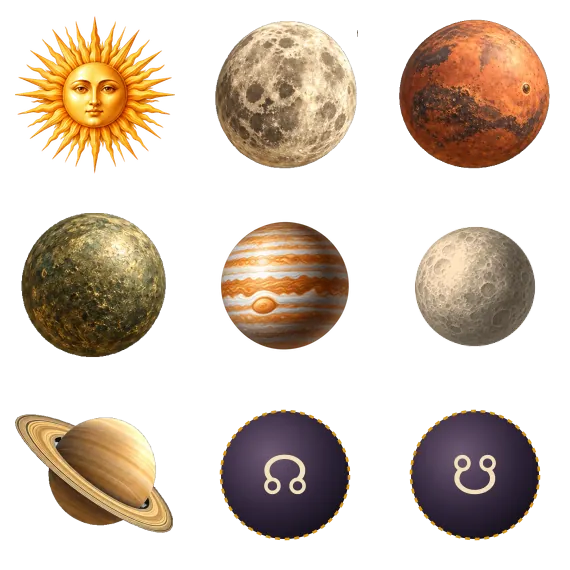
The nine grahas: the Sun, the Moon, Mars, Mercury, Jupiter, Venus, Saturn, and the two nodes Rahu and Ketu

Navagrahas: the nine planets and their role

Jyotisha works with nine grahas. The word means “that which seizes”: each is read as a distinct influence that colours the houses it occupies, the houses it rules and the planets it looks at. These are the themes traditionally linked with each:

  • The Sun

    Sun (Surya): the self and vitality, authority, confidence, the father and leadership.

  • The Moon

    Moon (Chandra): the mind and emotions, the mother, nurture, intuition and peace of mind.

  • Mars

    Mars (Mangal): energy, courage and drive, siblings, land and property; also anger and conflict.

  • Mercury

    Mercury (Budh): intellect and speech, learning, trade, writing and adaptability.

  • Jupiter

    Jupiter (Guru): wisdom, teachers, faith, growth, children and good fortune.

  • Venus

    Venus (Shukra): love and beauty, comfort, the arts, partnership and luxury.

  • Saturn

    Saturn (Shani): discipline and time, endurance, duty, service, and lessons that come through delay.

  • Rahu: ambition and desire, the unconventional, foreign lands and sudden change.

  • Ketu: detachment, spirituality, the past, research and sudden insight.

Rahu and Ketu are not physical bodies: they are the two points where the Moon’s orbit crosses the Sun’s apparent path, always exactly opposite each other, and eclipses happen near them. A planet marked (R) in your result is retrograde: seen from Earth it appears to move backwards, which astrologers read as its themes turning inward or returning to unfinished matters.

123456789101112Lagna

The twelve houses (Bhavas)

The chart is divided into twelve houses, each a field of life. Stella uses whole-sign houses, the older Vedic method: the Lagna’s sign is the first house, the next sign the second, and so on around the zodiac.

A planet’s house shows where its themes play out, and the sign on each house shows their style. These are the areas traditionally given to each house:

  • First house: self, body, appearance and temperament.

  • Second house: family, wealth, speech and food.

  • Third house: courage, siblings, communication and short journeys.

  • Fourth house: home, mother, comfort, property and inner peace.

  • Fifth house: children, creativity, learning, romance and past merit.

  • Sixth house: health, daily work, service, rivals and debts.

  • Seventh house: marriage, partnerships and open dealings.

  • Eighth house: longevity, sudden change, inheritance and what is hidden.

  • Ninth house: fortune, faith, teachers, long journeys and dharma.

  • Tenth house: career, status, action and reputation.

  • Eleventh house: gains, friends, networks and hopes fulfilled.

  • Twelfth house: expenses, sleep, foreign lands, letting go and liberation.

Asc123456789101112ArTaGeCnLeViLiScSgCpAqPiAscNorth IndianSouth Indian

North and South Indian charts

The same Kundli can be drawn two ways, and the calculator shows either. The information is identical; only the layout differs.

North Indian (the diamond): the houses stay fixed. The top diamond is always the first house, the Lagna, and the houses run counter-clockwise from it. The small numbers name the signs, from 1 for Aries to 12 for Pisces.

South Indian (the square): the signs stay fixed. Pisces is always the top-left square and the signs run clockwise; the Lagna is marked in whichever square it falls in, and the houses are counted from there.

Choose the style your family or your astrologer reads. Stella remembers the choice on this device.

One sign (Aries), 30°ArTaGeCnLeViLiScSg0°3°20′30°a planet at 11°Navamsa (D9): Cancer

Divisional charts (Vargas)

Each sign can be cut into smaller parts to build a divisional chart, or varga, that looks at one area of life in more detail. The Navamsa (D9) divides every sign into nine parts of 3°20′ and is read almost as carefully as the birth chart itself, especially for marriage, dharma and the inner strength of each planet.

Stella calculates the sixteen charts described by the sage Parashara. Pick any of them to sit beside the Rasi chart, or open the table to see them all:

  • Rasi: the birth chart: the whole of life.

  • Hora: wealth.

  • Drekkana: siblings and courage.

  • Chaturthamsa: home, property and fortune.

  • Saptamsa: children.

  • Navamsa: marriage, dharma and the strength of each planet.

  • Dasamsa: career and status.

  • Dwadasamsa: parents.

  • Shodasamsa: vehicles and comforts.

  • Vimsamsa: spiritual practice.

  • Chaturvimsamsa: learning and education.

  • Saptavimsamsa: strengths and weaknesses.

  • Trimsamsa: misfortunes and difficulties.

  • Khavedamsa: good and bad effects inherited through the mother’s line.

  • Akshavedamsa: character, and what comes through the father’s line.

  • Shashtiamsa: past karma: the finest division of all.

The finer the division, the more exact the birth time must be: the Lagna of the D60 changes about every two minutes.

Ke7Ve20Su6Mo10Ma7Ra18Ju16Sa19Me17birth0120 yearsNine periods, always in this order

Vimshottari Dasha: the chapters of your life

A dasha is a planetary period. The Vimshottari system gives a lifetime of 120 years to the nine planets in a fixed order: Ketu 7 years, Venus 20, the Sun 6, the Moon 10, Mars 7, Rahu 18, Jupiter 16, Saturn 19 and Mercury 17.

Your sequence starts with the ruler of the Moon’s nakshatra at birth. How far the Moon had already travelled through that nakshatra decides how much of the first period remained: the balance of dasha in your result.

Each mahadasha divides into nine antardashas, and each of those into nine pratyantardashas, in the same order and in proportion. Astrologers use them to discuss when themes in the chart are likely to come forward. Your result lists all three levels, dated by your birth place’s clock, and marks the one running now.

Stella measures dasha years as true sidereal solar years, the time the Sun takes to return to the same point among the stars, as Jagannatha Hora does by default.

Two Kundli charts side by side with a heart between them

Birth details (Avakhada)

The Avakhada chakra lists traditional classifications of your Moon. Its sign gives the varna, vashya and tatva (element); its nakshatra gives the yoni, gana and nadi; and its pada gives the name syllable.

Most of these are the categories of Ashtakoota matching, the traditional comparison of two charts before marriage, in which each is scored for compatibility. The name syllable, or namakshar, is the sound traditionally recommended to begin a child’s name.

Traditions differ on a few of these tables. Stella follows the classical texts and records the source for each; ask your astrologer if your family follows another.

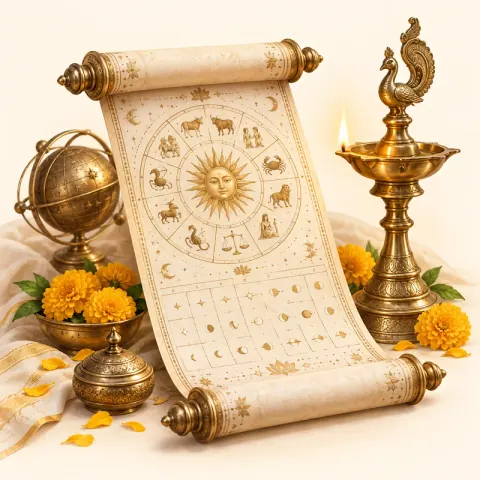
A Panchang scroll with a brass lamp and marigolds

Panchang at birth

Your result also records the Panchang of the moment you were born: the tithi (lunar day), the vara (weekday), the Moon’s nakshatra, the yoga and the karana. Together they describe the quality of the day, and families use them to keep birthdays and rituals by the Hindu calendar.

The Hindu day begins at sunrise, not midnight, so a birth before sunrise belongs to the previous vara. Your result says so when that happens.

Doshas

Doshas, and how to read them calmly

A dosha is a placement that tradition treats with extra care. They are common, many charts have one or more, and none of them is a verdict on a life. The classical texts also describe exceptions that soften or cancel a dosha.

Stella shows each dosha as a plain fact about the chart and applies no cancellations, because traditions differ on them. Read them with an astrologer rather than alone.

ManglikMarsKaal SarpRahu and KetuSade SatiSaturn
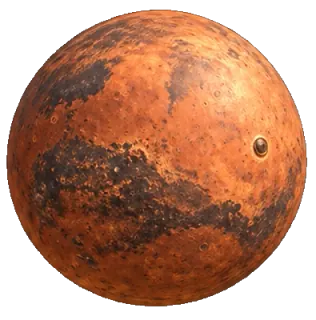
The planet Mars

Manglik (Kuja dosha)

A chart is called Manglik when Mars sits in the 1st, 4th, 7th, 8th or 12th house. It is traditionally weighed in marriage matching, where two Manglik charts are often seen as balancing each other.

Stella counts these houses from the Lagna and from the Moon, and shows the placement from Venus too. Some southern traditions also count the 2nd house; when Mars is there, your result says so.

SuMoMaMeJuVeSaRahuKetu

Kaal Sarp

Kaal Sarp describes a chart in which all seven planets, from the Sun to Saturn, fall on one side of the axis between Rahu and Ketu, as if held between the head and the tail of a serpent. Its twelve named types follow the house Rahu occupies.

It does not appear in the classical texts such as Parashara’s, and astrologers differ on how much weight to give it. Programs also disagree on the edge cases: Stella decides by exact position, many programs decide by sign, and when the two answers differ your result shows both.

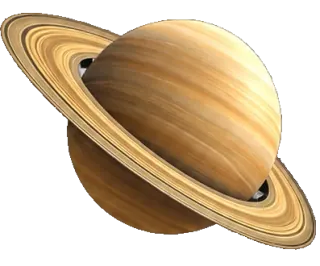
The planet Saturn with its rings

Sade Sati and Dhaiya

Sade Sati, “seven and a half”, is the time Saturn takes to pass through the sign before your Moon sign, your Moon sign itself, and the sign after it: about two and a half years each. It is traditionally a period of effort, responsibility and maturing rather than simply one of misfortune.

Dhaiya, the small panoti, is Saturn’s stay of about two and a half years in the 4th or 8th sign from the Moon.

Your result lists every Sade Sati and Dhaiya in your first hundred years, with dates found from Saturn’s actual movement. When Saturn turns retrograde it can step back out of a sign for a few months; the table shows that step as its own row.

Why it matters

How your Kundli can help

A Kundli gives you a shared language for the questions that matter: who you are, where your energy goes, which relationships and choices feel right, and when to act. Many people return to their chart at turning points: study and career, marriage, a move, a new venture or a difficult season.

  • Self-understanding: your Lagna, Moon and planets describe tendencies, strengths and patterns worth knowing.

  • Timing: the dashas and the movement of the planets help an astrologer discuss when themes are likely to come forward.

  • Relationships: the birth details and the Manglik placement are the basis of traditional matching.

  • Rituals and choices: tradition uses the chart to choose names and muhurtas, and to suggest remedies.

A Kundli describes tendencies within a tradition. It does not decide your life, and it is no substitute for medical, legal or financial advice. Stella’s astrologers use it as the start of a conversation, never as a verdict.

An open book and a telescope on a terrace looking out over hills

Before you calculate

Getting an accurate Kundli

The calculation is only as good as the birth details. A few checks make a real difference:

  • Use the recorded time: a birth certificate or hospital record is better than memory. If the time is uncertain, say so to your astrologer rather than guessing.

  • Choose the right place: every district of India is in the list, and the district headquarters is usually close enough; for a village, a birth abroad or somewhere exact, choose custom coordinates, which can start from this device’s location, and check the time zone.

  • Check the clock that was used: Indian births before 1956 may have been recorded in Bombay or Calcutta time. The calculator shows the offset it used and lets you correct it.

  • Keep it for later: signed in, you can save a Kundli and open it again, and any Kundli can be printed or saved as a PDF.

Stella calculates every chart with the Swiss Ephemeris, in the sidereal zodiac with the True Chitrapaksha ayanamsa, and checks its results against Jagannatha Hora. Nothing you type is stored unless you choose to save the Kundli.

AUG15DateTimePlace
✧ Interactive preview · Free to explore

A first look at a birth chart

Try a sample report. Birth details change the heading only; chart positions below are fixed examples.

District headquarters: New Delhi · 28.6139, 77.209

Use sample details if you prefer. Entries stay in this page and clear when you leave or refresh.

Your sample report starts here

Enter a few details to explore a chart, planetary themes and the idea of a dasha.

Before you begin

Come as you are.
Bring a little context.

  • Date of birth
  • Birth time, with its source and degree of certainty
  • Birth city and country
  • One or two questions you would like to explore

Good questions

A little more clarity

What if I do not know my birth time?

Say so rather than guessing. An astrologer can explain which parts of a reading depend on accurate timing and whether a time-rectification discussion is appropriate.

Is the chart calculated from my details?

The calculator at the top of this page is: Stella calculates it from your date, time and coordinates with the Swiss Ephemeris, for any date from 1801 to 2398, and stores nothing. The illustrated sample further down is a fixed educational example.

Is a Kundli the same as a Western birth chart?

Both use birth details, but systems may use different zodiacs, house methods and interpretive traditions. Ask your reader which method they use.

Some questions deserve a conversation.

Explore our astrologer profiles and find a guide for your next step.

Talk to Astrologer ↗
Kundli — Stella Astrology