Rashi
Your Moon sign: why Vedic astrology starts with the Moon
What your Rashi is, why Indian horoscopes are read from the Moon rather than the Sun, and what each of the twelve Moon signs is traditionally said to bring.
Ask someone in the West for their sign and they will usually give their Sun sign. Ask in India and you will often hear a Rashi: the sign the Moon was in when they were born. Vedic astrology gives the Moon a central place, and the reasons say a great deal about how the tradition sees a person.
The Moon and the mind
Jyotisha links the Moon with manas, the mind: feelings, memory, habits and the way we react. The Sun stands for the self and the will; the Moon for how that life is felt from day to day. A reading that ignored the Moon would miss the person living the chart.
Why horoscopes follow the Moon
The Moon moves quickly, through a whole sign in about two and a half days, while the Sun takes a month. The movement of the planets measured from your Moon sign is what makes a horoscope change from day to day. Sade Sati, the traditional matching of two charts and most rashiphal are all counted from the Moon.
Your Vedic sign may not be your Western sign
Vedic astrology uses the sidereal zodiac, which is tied to the stars; Western astrology uses the tropical zodiac, which is tied to the seasons. The two are now about twenty-four degrees apart, so most people’s signs move back by one when they switch systems. Your Moon sign, which depends on the exact hour of birth, may be different again from your Sun sign.
The twelve Moon signs
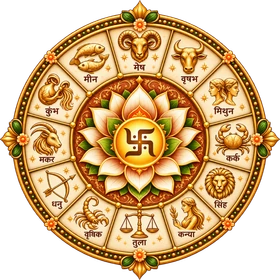
Each Rashi is traditionally associated with a temperament. These are broad themes, softened or strengthened by the rest of the chart:
- Mesha (Aries): energetic, direct and quick to act.
- Vrishabha (Taurus): steady, loyal and fond of comfort; the Moon is exalted here.
- Mithuna (Gemini): curious, talkative and quick-witted.
- Karka (Cancer): caring, sensitive and home-loving; the Moon’s own sign.
- Simha (Leo): warm, proud and generous.
- Kanya (Virgo): careful, practical and analytical.
- Tula (Libra): fair-minded, sociable and diplomatic.
- Vrishchika (Scorpio): intense, private and determined; the Moon is debilitated here.
- Dhanu (Sagittarius): optimistic, principled and fond of learning.
- Makara (Capricorn): disciplined, patient and ambitious.
- Kumbha (Aquarius): independent, idealistic and humane.
- Meena (Pisces): compassionate, imaginative and spiritual.
A strong Moon and a weak Moon
Astrologers also weigh the Moon’s strength: whether it was waxing or waning at birth (a Moon near full is traditionally considered strong), its sign and house, and the planets around it. The same Moon sign can therefore read very differently in two charts.
Finding your Moon sign
Enter your birth date, time and place in Stella’s Kundli calculator. Your Rashi appears near the top of the result, with the Moon’s nakshatra and pada, and the Moon is marked in every chart.
This article is general information about the traditions of Indian astrology, written by Stella Editorial. It is not a personal reading, a prediction or professional advice. For guidance on your own chart, talk to an astrologer.