Vaastu
Vaastu at home: simple principles for a calmer space
The five elements, the eight directions and ten practical ideas from Vaastu Shastra that you can apply without breaking a single wall.
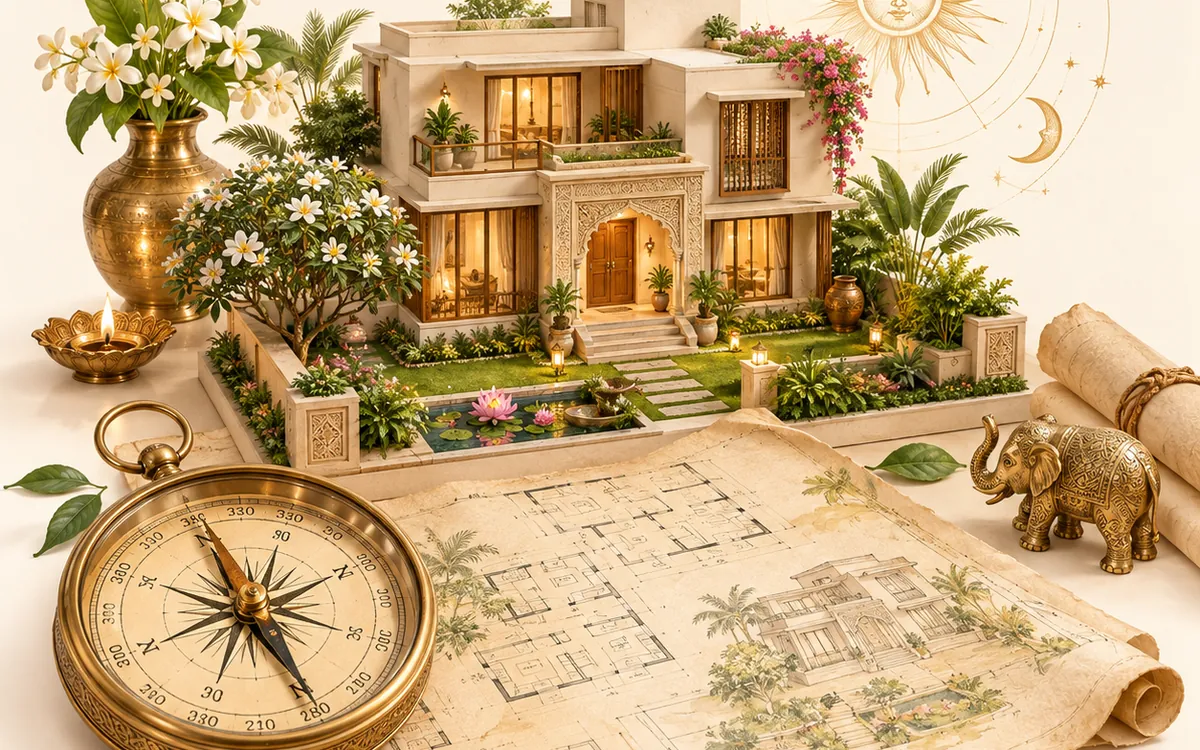
Vaastu Shastra is India’s traditional science of space: how a home or a workplace is placed, shaped and arranged in relation to the directions and the five elements. You do not need to rebuild a house to use it. Many of its ideas are about light, air, order and intention, and they begin with small changes.
The five elements
Vaastu sees every space as a balance of the five elements, the panchabhutas:
- Earth (Prithvi): stability: the ground, the walls and heavy structures.
- Water (Jala): flow and renewal, associated with the north-east.
- Fire (Agni): energy and transformation, associated with the south-east.
- Air (Vayu): movement and freshness, associated with the north-west.
- Space (Akasha): openness, held at the centre of the home.
The eight directions
Each direction has a presiding deity and a traditional purpose:
- North: Kubera: wealth and opportunity. Keep it open and uncluttered.
- North-east (Ishanya): the most sacred corner: for prayer, meditation and water.
- East: Indra, with the rising Sun: light, health and new beginnings.
- South-east (Agneya): Agni: the traditional place for the kitchen.
- South: Yama: rest and stability; suited to bedrooms and heavy furniture.
- South-west (Nairutya): the steadiest corner, often chosen for the main bedroom.
- West: Varuna: suited to dining rooms and study.
- North-west (Vayavya): Vayu: movement; guest rooms and storage.
The centre of the home, the Brahmasthan, is traditionally kept open and free of heavy furniture.
Ten simple ideas to start with
- Keep the entrance welcoming: clean, well lit and free of clutter, since it is where the home is entered.
- Let in the morning light: keep east-facing windows clear and open where you can.
- Give the north-east to calm: a small prayer space, plants or water; avoid heavy storage and bins there.
- Cook in the south-east: the traditional choice for a kitchen, with the cook facing east.
- Sleep in the south-west: with your head towards the south or the east.
- Keep the centre open: no heavy furniture or clutter in the middle of the home.
- Put heavy things to the south and west: cupboards and heavy furniture along these walls.
- Mind the mirrors: avoid a mirror that faces the bed.
- Mend what is broken: leaking taps, stopped clocks and stuck doors are traditionally seen as blocks.
- Declutter regularly: on this, Vaastu and common sense agree.
Tradition and common sense
Many Vaastu principles line up with good design: morning light from the east, air that can move through the house, a quiet corner for prayer or study, and an uncluttered centre. Where a home cannot follow a rule, practitioners suggest adjustments rather than demolition.
Vaastu is a tradition, not a building code. Follow structural safety and local regulations first, and consult a qualified practitioner before any major change.
Starting with your own home
Stella’s Vaastu page walks you through your home room by room, with a checklist you can keep as you go.
This article is general information about the traditions of Indian astrology, written by Stella Editorial. It is not a personal reading, a prediction or professional advice. For guidance on your own chart, talk to an astrologer.